Case Flow System — the full platform

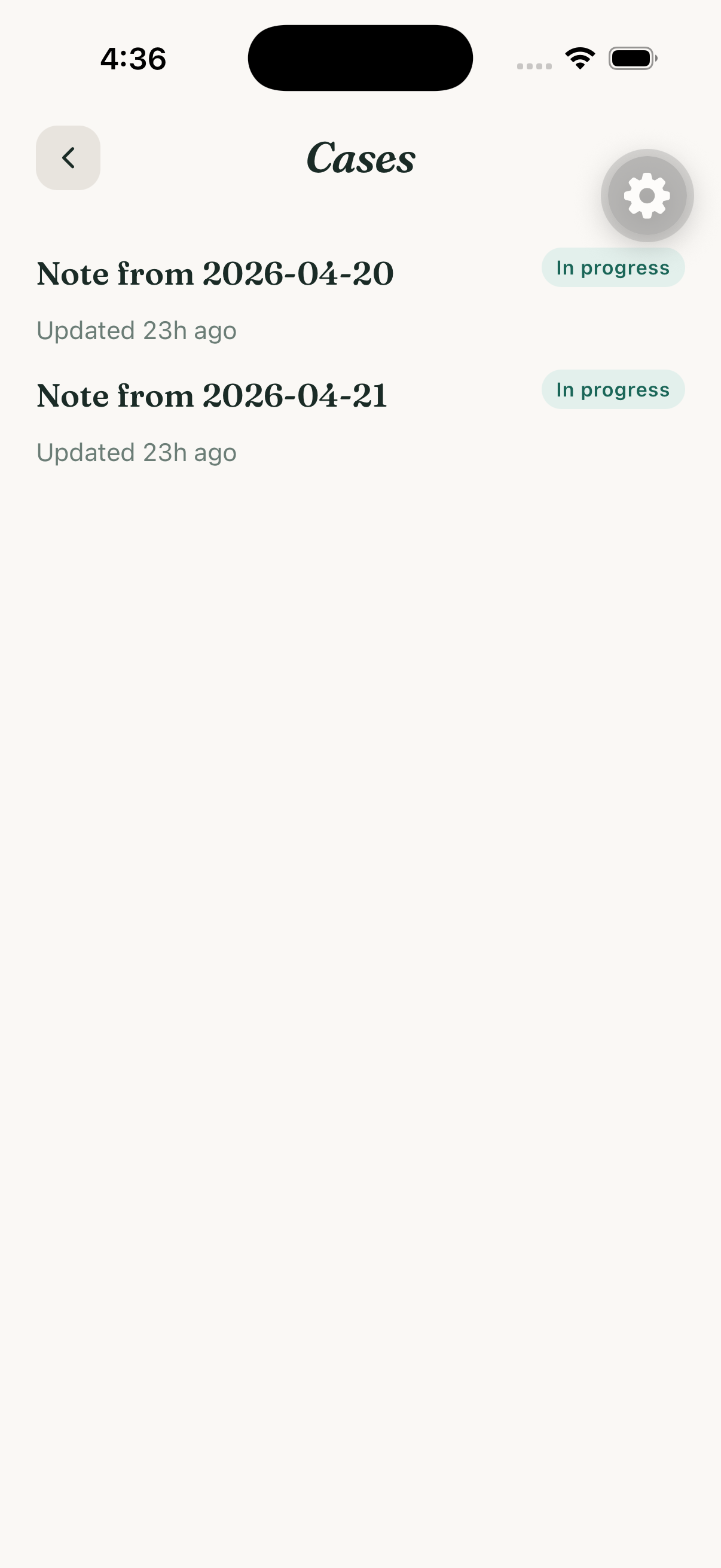
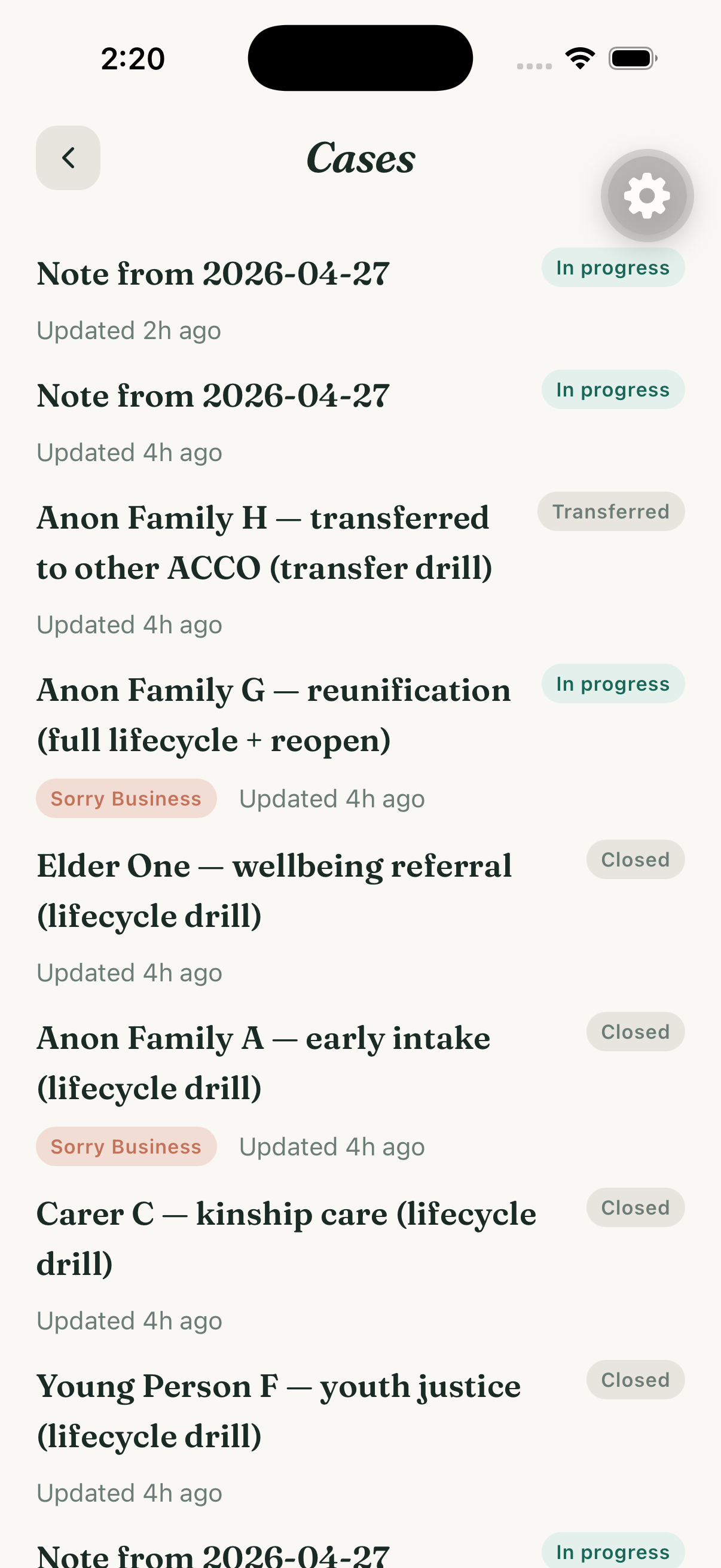
Case management
that holds the case.

From referral through closure — solution-focused, culturally safe, AI-drafted, audit-evidenced. Built for ACCHOs, NDIS providers, and family-services NGOs across Australia.

01 · Assessment 02 · Planning 03 · Progress 04 · Closure

Case Flow System is the full case-management platform from the team behind the Case Flow note app — built in Australia, alongside ACCO partners, for the practitioners actually doing the work.

01

The case lifecycle.

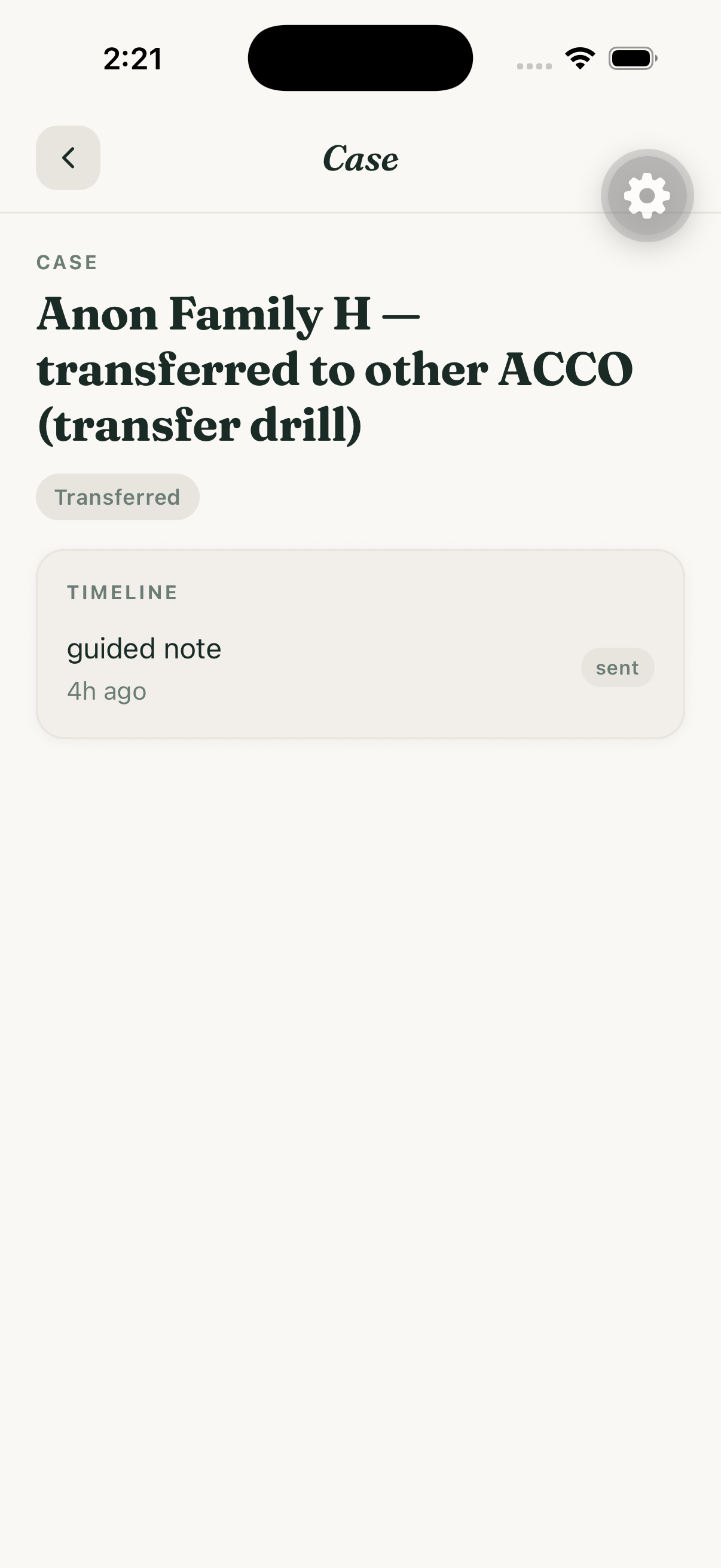
Every case Case Flow System holds moves through four stages. Each stage has its own colour, its own questions, its own artefacts. The schema is a state machine; the practitioner sees a calm, structured journey.

01 Assessment

The future picture.

Solution-focused opening. The miracle question, scaling 0–10, worries with immediacy triage. Strengths surfaced before risks.

  • Future pictureWhat would you see if things were going really well?
  • Scaling question0 = nowhere yet · 10 = your future picture
  • Worries with triageYes, now · Keep an eye on it · Not right now
02 Planning

Next small steps.

No five-year plans. Just the next achievable step the family chose, with who's doing it and by when.

  • Step textFree-text, family-authored, voice-capable
  • WhoFamily · Practitioner · Together
  • By when"This week" / "next visit" / 5 May
03 Progress

Visit by visit.

Adaptive empathic copy that responds to the family's scaling score. A relapse never gets a "celebrate!" prompt.

  • If the score went up"Things are moving — that matters."
  • If it stayed the same"Staying steady takes strength too."
  • If it went down"Things must feel tough. We're here with you."
04 Closure

A meaningful ending.

Journey statistics. Future-self letter. Advice-to-others letter. Supervisor sign-off. Endings as positive transitions, not paperwork.

  • Journey cardVisits · steps completed · strengths identified
  • Future-self letterOptionally scheduled to deliver in 6 months
  • Supervisor sign-offStatus dots until formally closed

The schema is a state machine. The practitioner sees a calm, structured journey. The supervisor sees status. The family hears questions, not forms.

02

Solution-focused practice, baked in.

Most case-management software calls itself "strengths-based" in the marketing copy, then ships a deficit-shaped form. We did the opposite — encoded the methodology in the schema first, and let the UI follow.

SF

Solution-Focused
Brief Therapy

de Shazer · Berg

The miracle question. Scaling. Exception-finding. The language of small steps. All encoded as adaptive prompts and column-level state.

SoS

Signs of
Safety

Turnell · Edwards

What's working. What we're worried about. What needs to happen. Mapped directly to the assessment frame and the worries-with-triage schema.

N

Narrative
Therapy

White · Epston

Externalising the problem. Letter writing. Future-self correspondence. Case Flow System productises these as first-class artefact kinds.

Not bolted on. It is the spine.

03

Practitioner wellbeing — first-class.

The single biggest unsolved problem in community-services tooling: the workforce burns out. Case Flow System treats wellbeing as a feature with first-class plumbing — encrypted notes, EAP integration, supervisor flag with consent boundary, timed self-callbacks.

Pre-session check-in

How are you doing, Sarah? Take a moment before the session.

Post-session

Was there anything in this conversation that was hard to hear?

Flag for my supervisor Consent-respecting. Supervisor sees the fact, never the note.
Access EAP support Org-configured. Single tap.
I'll come back to this later End of today · Tomorrow morning · Later this week

The privacy invariant

Practitioner wellbeing notes are encrypted client-side with a per-user key wrapped by the practitioner's passphrase + biometric. The unwrapped key never touches the server. Supervisors can see that a flag was raised; they cannot read the content.

  • 1Row-level securityOrg-scoped read; flag-only supervisor view
  • 2Column-level GRANTnote_encrypted SELECT revoked from authenticated
  • 3AES-256-GCMPractitioner-only readable. Loss of key = unrecoverable. Deliberate.
04

Cultural safety as default.

Not an option toggle. The defaults are designed for ACCHO deployment from the first install — and informed by VACCHO and SEWB framings. ACCO partners are co-designers, not consultees.

Kinship-aware attendees

Default chips include Elder, Aunty / Uncle, Extended kin, Cultural support worker, Community member — not just the nuclear-family schema.

SEWB framework

Connection to body, mind, family, kin, community, culture, country, spirit — surfaced in assessment prompts and journey summaries.

ACPP-aware schema

Aboriginal Child Placement Principle — prevention, partnership, placement, participation, connection — encoded as first-class case attributes when child welfare is in scope.

Sorry Business mode

A per-client flag that suppresses names and photos in UI in line with cultural protocols around the deceased. Designed with community input.

CARE-aligned governance

Per-client and per-org data-governance envelope. Indigenous Data Sovereignty principles (Maiam nayri Wingara) honoured at the row level.

Co-designed, ongoing

Rumbalara Aboriginal Co-operative is our launch partner. Cultural-safety copy review continues with VACCHO and SEWB Elders before any new copy ships.

05

AI you can defend.

Documentation is forensically read by child protection, sometimes coronial processes. Any AI-introduced phrase that changes meaning is a direct risk to a worker and to a family. We solved this at the schema level.

i

Provenance always

Every AI-generated sentence traces back to the practitioner's spoken input. Visible on demand. Stored as structured JSONB on the artefact, not as a vibe.

provenance: [{ sentence, source, source_ref }]
ii

AI drafts, human authors

Every artefact runs through review and supervisor sign-off where the routing requires it. State machine: draft → generated → pending_review → approved → sent. No direct-write.

17 artefact kinds. One framework.
iii

Ask anything about this case

Case-grounded retrieval with provenance. Constrained to one case's records. Cannot leak across cases. Practitioners get answers; the source citations come with them.

RAG with row-level security at the source.

Three AI providers · pluggable · always with a "use my words" template-assembly fallback that never fails.

A
Azure OpenAI GPT-4o · Australia East
V
Vertex AI Gemini australia-southeast1 · Sydney
G
On-device Gemma 4 llama.rn · Apache 2.0 · nothing leaves the phone
·
Use my words Template assembly · zero AI · always succeeds

17 artefact kinds, one framework:

06

Compliance, not theatre.

Every claim below maps to an actual artefact in the codebase or a documented mapping in the privacy register. ACCHO procurement teams: the vendor audit pack is downloadable on request.

Standards we map to

  • Privacy Act 1988 + APPsIncluding APP 11 (security of personal information).
  • Notifiable Data Breaches schemeMandatory breach notification posture.
  • ISO/IEC 27001 postureInformation security management system aligned.
  • Healthcare Identifiers Act 2010IHI / HPI-I / HPI-O integration pathway ready.
  • NDIS Practice StandardsCode of Conduct + restrictive-practices register.
  • MARAM · SDM · VARMRisk-assessment frameworks supported by schema.
  • AIHW SHSC alignmentSpecialist Homelessness Services Collection-ready.
  • DEX-ready data shapeDepartment of Social Services Data Exchange.
  • FHIR AU CoreExport pathway for Patient · Encounter · DocumentReference.

Technical evidence

  • Cryptographically tamper-evident audit chain Every event SHA-256-hashed, chained per organisation. verify_audit_chain(org_id) returns the first divergent row.
  • AU-only data residency Supabase ap-southeast-2 · Sydney. Cloud AI providers Australia East / australia-southeast1.
  • On-device LLM for highest sovereignty Gemma 4 via llama.rn, Metal GPU on iOS, CPU on Android. Nothing leaves the device.
  • Per-org single-tenant deployment Available for high-sovereignty ACCOs. Your Supabase project, your data, your region.
  • Practitioner wellbeing encryption Per-user AES-256-GCM data key. Loss of passphrase + biometric = unrecoverable. Deliberate.
  • RLS, column-level grants, immutable audit Row-level-security on every case-shape table; note_encrypted SELECT revoked from authenticated; audit_events immutable via mutation triggers.
07

Built for the workforce actually doing the work.

Three sketches drawn from real pilot personas. What changes for them: shorter docs time, defensible evidence, supervisor visibility, family-readable artefacts.

J
ACCHO

Jess — 24, Family Worker

Positive Ageing support, Aboriginal Co-operative. Five-to-seven Elder home visits a day. Writes notes between visits in the carpark, on a cracked iPhone mini, one-handed.

What changes: Quick capture in under two minutes. Voice-first. Cultural framings default. Discreet mode for in-home privacy. The whole shift documented before she gets home.

P
NDIS

Priya — 29, Support Coordinator

NDIS community support, regional Victoria. Forty-minute drives between participants. Wants something she can talk to while the kettle boils at home.

What changes: Hands-free capture en route. Plan-aware drafts. NDIS progress reports as a one-click artefact, with provenance and supervisor review. PRODA-ready line items in the roadmap.

N
Family Services

Nathan — 31, Case Manager

Joint DFFH caseload. Documentation is forensically read by child protection — sometimes by coroners. Any AI phrase that subtly shifts meaning is a direct risk to him and to a family.

What changes: Sentence-level provenance. Supervisor sign-off. Tamper-evident audit chain. Court-report drafts from the artefact framework with full source citations. Every word defensible.

08

What's here, and what's coming.

Procurement teams: an honest list. Available is what you can use today in pilot. Roadmap is what we are building, in priority order, and where you can shape it.

Available now

In the pilot build

  • Case lifecycle — Assessment / Planning / Progress / Closure
  • Solution-focused assessment with adaptive empathic copy
  • AI drafting with sentence-level provenance
  • Supervisor review and sign-off workflow
  • Attachments + AV scan + signed-URL audit-on-access
  • Cryptographically tamper-evident audit chain
  • Multi-tenant cloud or single-tenant per-org Supabase deployment
  • Feature flags — per-org rollout of new surfaces
  • Practitioner wellbeing flow with encryption
  • On-device LLM (Gemma 4) for highest data sovereignty
On the roadmap

Building, prioritised by partners

  • ·nKPI / OSR auto-export (ACCHO sector)
  • ·FHIR AU Core write-back (Patient · Encounter · DocumentReference)
  • ·Communicare integration — bi-directional
  • ·Family portal — family-readable closure summaries and letters
  • ·Scheduled-delivery letters (e.g. future-self letter in 6 months)
  • ·DEX export — Department of Social Services Data Exchange
  • ·PRODA / NDIS Online Services line-item claiming
  • ·HPI-O / IHI lookup via Services Australia
  • ·WCAG 2.2 AA full audit + remediation
  • ·IRAP-PROTECTED assessment (for govt-tier procurement)
09

Pricing finalised post-pilot.

Three tiers. Co-design partners get materially better terms. Pricing is intentionally placeholder until we have pilot benchmarks — talk to us.

For pilots

Pilot

For ACCHO co-design partners.

$·talk to us

  • Full case-lifecycle surface
  • Cultural-safety co-design sessions included
  • Direct line to product
  • Materially-better commercial terms
  • Roadmap influence
Talk to us →
Most orgs
Default

Org

For NDIS providers, family-services NGOs, ACCOs at scale.

$·per seat / month

  • Everything in Pilot, no co-design commitment
  • Supervisor & admin surfaces included
  • Audit pack on request
  • EAP + wellbeing config
  • Annual or monthly billing
Get a quote →
For high-sovereignty

Enterprise
/ Single-tenant

Your Supabase project. Your region. Your audit posture.

$·custom

  • Per-org dedicated Supabase project
  • IRAP-PROTECTED assessment pathway
  • Customer-managed encryption keys
  • SLA + dedicated support
  • Migration assistance from legacy CMS
Speak with us →

Pricing finalised post-pilot. We're documenting unit economics openly with launch partners; if that matters to your procurement team, we'll share what we have.

10

Honest answers.

The questions ACCHO procurement leads, NDIS managers, and clinical advisors ask first.

Is it ready?

For pilot, yes. The case-management backbone is built and live: 13 SQL migrations, 7 code modules, an additive dual-write trigger that populates the case-shape schema from every save, a tamper-evident audit chain, encryption for wellbeing notes, and 715 passing tests. Production rollout to broad customers starts after the launch partner cohort completes their pilot.

How does this relate to the existing Case Flow note app?

It's the next chapter — same data model, same brand, expanded surface. Existing Case Flow users transition seamlessly: every note they have is already a case-record under the hood, ready to surface as part of a case when the case-shape UI flips on for their org. No migration. No re-platforming. Looking for the focused note-taking app? It's still right here.

Where is our data hosted?

Supabase ap-southeast-2 (Sydney) by default. Cloud AI providers run in Australia East (Azure) and australia-southeast1 (Vertex Sydney). For high-sovereignty orgs we offer per-org single-tenant deployment — your own Supabase project, your own region within Australia, your own keys. On-device Gemma 4 means data never leaves the phone for orgs that need that posture.

Can we deploy on-prem?

Self-hosted Supabase is an option for the single-tenant tier. Practically, most ACCHOs and NDIS providers find ap-southeast-2 with our IaC-provisioned per-org project meets their sovereignty requirements without the overhead of running their own infrastructure. We're happy to walk through both paths.

Does it work offline?

Yes. The capture surfaces work offline — voice, drafting (via on-device LLM), review, export. Notes live locally first; cloud sync is optional and visible. Cell-dead carparks and remote communities were design constraints, not afterthoughts.

What about cultural safety?

Cultural safety is the default, not an option. Kinship-aware attendees, SEWB framework prompts, ACPP-aware case attributes, Sorry Business mode, CARE-principles-aligned data governance. ACCO partners are co-designers, not consultees. Copy review is ongoing with VACCHO and SEWB Elders before any new copy ships.

What's APP 11?

Australian Privacy Principle 11 — Security of personal information. We have a documented mapping from APP 11 obligations to the technical controls in Case Flow System (encryption at rest, RLS, role-based access, audit-on-access, retention policy, customer-managed keys for high-sovereignty orgs). The mapping document is in the audit pack, downloadable from the procurement portal once you're in pilot.

Can we have our own Supabase project?

Yes — that's the Enterprise / Single-tenant tier. Provisioned via Terraform (we have the IaC). Same migration set, same code, your own data plane. Useful for orgs pursuing IRAP-PROTECTED or for ACCHOs whose data-sovereignty principles require dedicated infrastructure.

Who owns our data?

You do. Always. Your data is exportable (full FHIR-AU-Core JSON, or CSV per table) at any time. We do not train AI models on customer data. We do not sell, share, or aggregate it. Termination = full export + verified deletion. Written into the contract.

What does the audit pack include?

APP 11 mapping, RLS posture document, audit-chain integrity doc, encryption-at-rest design, AI provider details (location, retention, training stance), DPIA template, retention/deletion playbook, single-tenant runbook, IRAP scoping notes. Provided as PDFs to procurement teams once a pilot conversation is in progress.